08.10.22
Why Science Is Still Slow
This summer, I worked on a robot whose job was to move stem-cell well plates.
It did not discover a new drug or invent a new kind of cell therapy. All it did was pick up a plastic tray, carry it steadily across a table, and place it in another machine for analysis.
This sounds like a small solution to an isolated problem. But I believe it may be the beginning of something much larger.
Stem cells are fragile, expensive, and highly regulated. They also hold enormous potential for treating diseases that medicine still struggles to address. The researchers we worked with at the Georgia Tech Research Institute had a simple but costly problem: samples could be spoiled before they were ever analyzed.
An experiment might take weeks to prepare, but a small mistake while moving a plate or an environmental change could contaminate or warp the contents, distorting the result.
Our task was to remove the human from this part of the workflow.
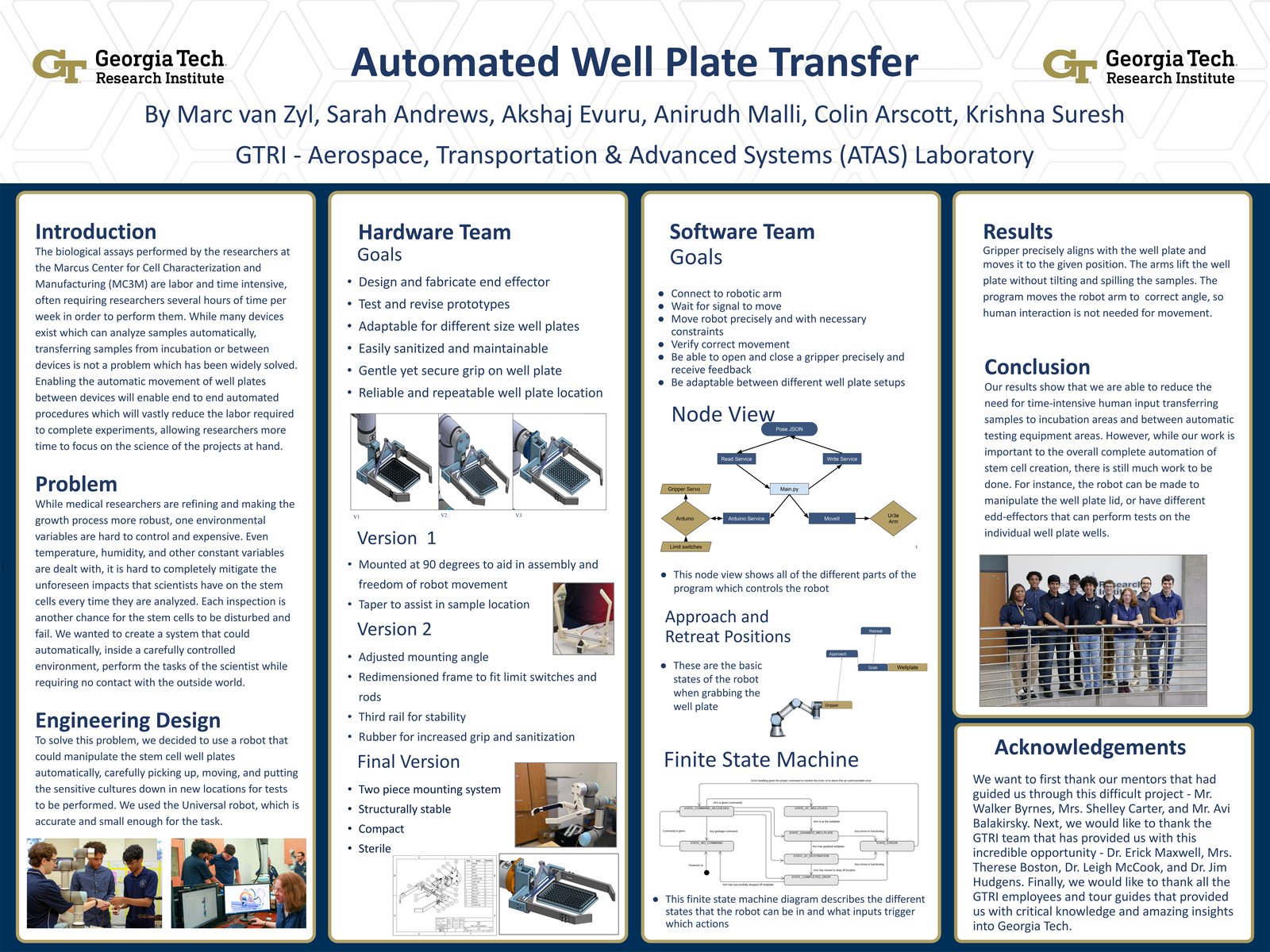
We built a custom 3D-printed gripper with limit switches that verified whether the plate was secure. We attached it to the end effector of a UR3 robotic arm. The software used a finite-state machine to decide what action to take next, detect errors, and stop before damaging a sample.
We also wanted the system to be usable by scientists who did not know how to program. A researcher could manually teach the robot a destination once, save it, and allow the system to return there later.
We finished the internship requirements a few days early. The proudest moment came when we watched the robot operate inside a clean room at Georgia Tech's Marcus Nanotechnology laboratory, moving fragile samples without spilling, tilting, or exposing them unnecessarily.
At first, I thought we had solved a robotics problem.
By the end of the summer, I realized we had encountered a much larger problem about how science itself works.
What We Learned
Three things became clear.
First, a ten-week engineering project could save scientists thousands of hours over the lifetime of the system. Every plate the robot moved was one less plate a trained PhD-level researcher had to carry manually. The value was not just that the robot worked faster, but that the scientists could spend more time doing real research rather than clerical work.
Second, the hardest part was building the physical interface.
The robot arm already existed. The machines for analysis already existed. But nothing connected them. We had to design the gripper from scratch, test several versions, account for different plate dimensions, add feedback through limit switches, and make the mechanism stable enough to hold a delicate sample without damaging it.
Once the gripper worked, the remaining task was mostly calibration: teaching the robot where each machine was and defining the approach and departure paths through their absolute coordinates.
Third, our robot was autonomous only in a narrow sense.
It could perform the task by itself after someone had carefully configured it. But it could not understand a new laboratory setup, recognize a slightly different plate, or adapt when a machine was moved a few inches. A roboticist still had to tell it exactly what the world looked like.
It was autonomous, but not very smart.
This distinction matters. A system that repeats one carefully programmed motion is useful. But it is not yet a general solution. Every new machine configuration required another round of integration, calibration, and testing. If no one with robotics experience was available, the robot might simply go unused. We knew this while creating the robot, that it was unlikely it would create any long-term change other than for the narrow task we had designed it for, a somber realization given I spent my entire summer building this!
The harder question was whether we could build something that worked beyond this one setup, something that would scale commercially.
The Human Is the Middleman
This pattern appears throughout science.
A modern laboratory may contain millions of dollars of sophisticated equipment. Machines can image a sample, analyze its chemical composition, control temperature, humidity, and incubation time with extreme precision.
But the experiment is often still held together by a scientist, who is most of the time working on clerical tasks that even I could have done as an 8th grader on my Experimental Design Science Olympiad team.
A scientist moves the plate from one machine to another, copy measurements into another system, set timers, label samples, prepare reagents, and remember which step comes next.
The machines are automated. The laboratory is not. The human is the middleman.
This is one reason science progresses more slowly than computing.
A program can be copied and run a thousand times with nearly identical behavior. An experiment is much harder to copy. And every human that's added in the mix introduces unsolicited errors that can further differentiate the results of seemingly identical experiments.
We know the solution to this, we've solved it countless times in other industries — automation.
So the problem is not only that laboratories need more robots. The problem is that these robots need to be reusable across experiments, programmable, and take care of all the clerical work involved in doing an experiment. That is what leads to market adaptation.
Making Experiments Programmable
A programmable experiment would describe more than just the starting and ending coordinates of machines, like we defined in our project.
It would specify how each instrument should perform those steps, what data should be recorded, how success should be verified, and what the system does when something goes wrong. That would ensure a truly autonomous finite state machine.
The last part is probably the most important. The robot, likely through computer vision, should be able to self-correct when it realizes it has done a mistake rather than continuing. Why is it that we have Teslas that can self correct their driving on nearly every road in America but not lab robots that could save millions of hours of time from our country's smartest people?
The Companies Building this Future
Several companies are working towards solving this problem, but two of them stood out to me.
Opentrons. Automate repetitive tasks with a programmable laboratory. Example: steady pipetting over a set period of time that would usually be done by a researcher.
Emerald Cloud Lab. Rather than selling only a machine or a software, they operate automated laboratories that researchers can access remotely. Experiments are distilled down into their core, structured instructions and executed by the cloud laboratory.
My Thesis
My thesis is that laboratory robots will be valuable, but the biggest companies in this space will not stop at selling individual robots. They will build the entire autonomous laboratory around them.
The hardware manufacturers will be big. Different experiments will require different grippers, sensors, liquid handlers, and robotic arms. They will continue to improve in precision over time as they have for the past 20 years.
But the robot alone solves only one step of an experiment. Its value increases dramatically when it can communicate with other instruments, adapt to new workflows, verify its own actions, and recover when something goes wrong.
The best companies will combine three things: specialized robotics, software that coordinates the laboratory, and the scientific domain expertise required to choose experiments.
Every laboratory is arranged differently, just like automobile factories. A company that runs thousands of experiments will gradually be the best suited to learn how to handle these differences and encode that into its automation.
This creates a compounding advantage, the key piece that has been missing in this industry until now. Each new robot expands what the laboratory can do. Each new experiment validates the domain expertise scientists provide and allows them to choose the next, more pertinent one. Each failure improves its ability to recognize and correct future failures.
The largest company in this space probably will not look like a traditional robotics company or a traditional software company. It will have to build both.
The Compounding of Science
Large, well-funded laboratories can already justify expensive custom robotics. But custom automation can only take them so far until the incentives no longer align — it's simply too expensive given most experiments are often long-shots with a small chance of commercial value anyways.
The larger opportunity is to make these systems deployable without a team of roboticists and specialized engineers. A smaller laboratory should be able to add an instrument, show a workflow, and begin automating it without rebuilding the entire system.
Experiments will run more often, with less interruption, and more precisely. Researchers will be empowered to test more hypotheses with the same amount of time and funding.
Most importantly, knowledge could begin to compound, since better experiments will produce better data. Better data would train better models, as we've seen through the deep learning revolution. Better models would propose better experiments. And there the learning loop is closed and repeats.
Semiconductors improved through decades of compounding. Software improved because programs could be copied, open sourced, and distributed at cheap prices. The internet accelerated knowledge by making information easier to access and compound.
Laboratory science has not experienced the same rate of compounding because the physical execution of experiments remains slow.
Science is often romanticized to be the search for new ideas. But ideas are only half of the loop. The experiment is the difficult part, and we are just at the beginning of bringing the power of compounding technology to laboratories.